An assessment of adaptive behaviour styles, working reactions under pressure and communication risks. For executives, HR, teams and specialists who need to understand not only «what a person is like» but how they act as the load grows.
JPAQ helps translate the language of personality adaptations into management conclusions: how a person communicates, what they rely on, where they overheat and what conditions raise their effectiveness.
The personality adaptations questionnaire gives you a working language for discussing behaviour without labels: strengths, automatic reactions, stress risks, contact style and development areas.
Understand what helps a leader manage people, delegate, hold pressure and not damage the relationship.
Assess behavioural risks, fit for the role, decision-making style and the likelihood of conflict.
See why a team stalls: who speeds things up, who slows them down, where misunderstandings and hidden tension arise.
Build a concrete development plan: how to manage stress, communication and repeating behavioural scripts.
In business language, personality adaptations are easier to understand as stable ways of adapting to an environment: how a person solves problems, builds contact, defends against tension and restores their effectiveness.
There are no «good» or «bad» adaptations. Each style can be a resource in some conditions and a source of management risk in others.
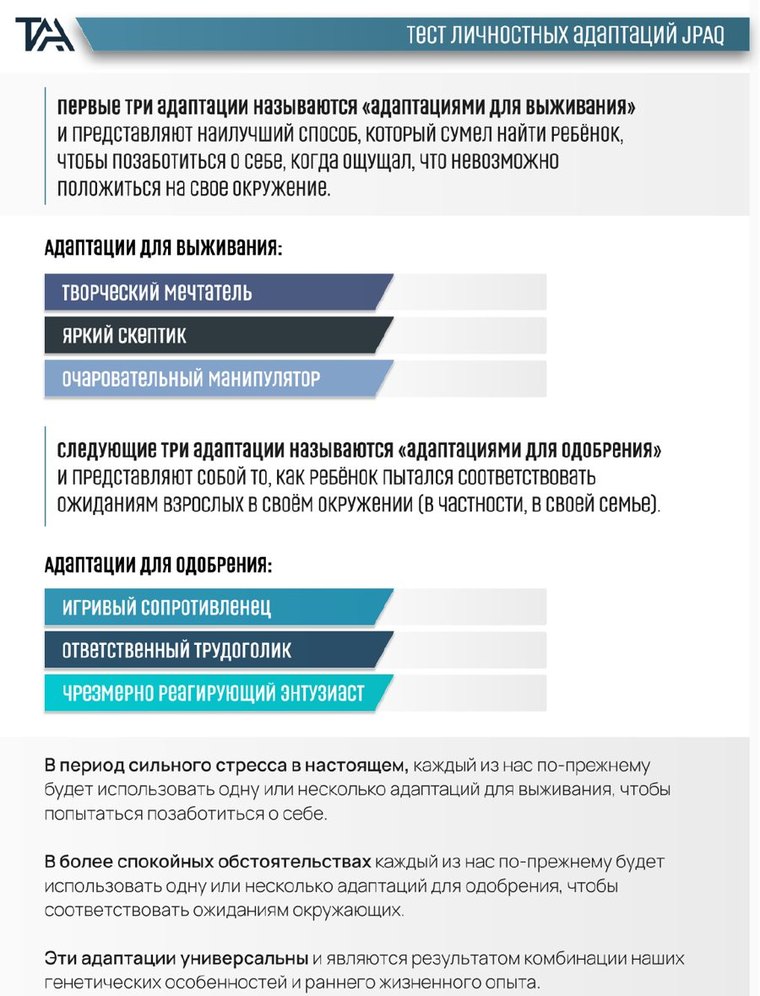
Strategic thinking, depth, analysis, the ability to see what is not on the surface.
Quality control, attention to risk, precision, the ability to ask uncomfortable questions that matter.
Speed, decisiveness, influence, a focus on results and opportunity.
Flexibility, creativity, a sense of humour, the ability to defuse tension.
Systematic thinking, order, dependability, discipline and high quality standards.
Energy, engagement, communication, the ability to build emotional contact quickly.
The first three adaptations describe early ways of coping with reality and tension. The next three are ways of gaining approval, maintaining contact and meeting the expectations of the environment. It is the combination of adaptations that explains a person's actual behaviour in a team.
JPAQ does not make clinical diagnoses. When working with the results we talk about adaptive behaviour styles, working patterns, communication risks and development areas.
JPAQ helps you quickly see a person's stable behavioural patterns: how they build contact, make decisions, respond to pressure, enter conflict and recover their effectiveness after stress.
It is a practical instrument for assessing employee behaviour, developing executives, HR assessment, executive coaching, team coaching and diagnosing communication within a team. Unlike general personality descriptions, JPAQ shows which adaptive styles become a resource and which can turn into a risk under overload, uncertainty or high demands on results.
understanding management style, reactions under pressure and a leader's growth areas
seeing the causes of tension, conflict and communication breakdowns
adding a behavioural and stress profile to a competency assessment
turning repeating scripts into a concrete action plan
Key objectives: personality adaptations questionnaire, JPAQ, assessing employee behaviour, reactions to stress, communication within a team, developing executives.
JPAQ was created by Vann Joines on the basis of the personality adaptations model. The Russian-language version went through modification, psychometric testing, standardisation and norming on a Russian-speaking sample.
Key facts about the method: it is licensed for the Russian-language version, adapted for the language and culture, intended for adults, and can be used in individual work, HR processes, team coaching, career guidance and development programmes.
The results of a personality adaptations questionnaire matter not on their own but in professional interpretation: how adaptive styles show up in work, communication, management decisions and relationships.

Managing partner at Psychometric, lecturer. Works with executives and teams at the intersection of psychometrics, communication and organisational development.

A psychologist and psychotherapist with more than 10 years of experience. Works with behavioural scripts, communication, inner conflicts and resilience in relationships. Helps clients understand themselves better, make decisions and build more mature interactions with people.
For an individual participant, the test plus a consultation works well. For companies — a team format or a custom programme built around the assessment and development objective.
We will prepare a proposal for your objective: assessing executives, team diagnostics, a development programme, the talent pipeline, communication training or a team session.
We reply within one business day
Everything worth knowing before you start the JPAQ questionnaire.
We will look at your objective, show you a sample report and suggest how to use JPAQ for an individual assessment, a team or a corporate programme.
We reply within one business day